

Storm guide
Emergency storm damage roof repair on the Treasure Coast
After a storm, document the damage from the ground within the first 24 to 48 hours, get an active leak tarped, and report the claim to your carrier. In Florida, a new or reopened property insurance claim must be reported within one year of the date of loss, and a supplemental claim within 18 months. Stay off a wet, storm-loaded roof.
★ 5.0★ · 60 Reviews
Last updated:
Storm damage roof repair in Port St. Lucie
What should I do in the first 48 hours after storm damage?
In the first 48 hours, stay off the roof, photograph the damage before anyone touches it, tarp an active leak, and report the claim in writing. Do not start a permanent repair before the adjuster inspects. Keep every receipt, and have a licensed Florida roofer inspect before the carrier's adjuster arrives so you already know what is on the roof.
- Stay off the roof. Wet decking and hidden structural damage are how people get hurt. Assess from the ground or from a window.
- Photograph before you touch anything. All four elevations wide, close shots of missing shingles or cracked tile, displaced material in the yard, every interior ceiling and wall stain, and the attic if you can reach it safely.
- Stop the water. Tarping an active leak is expected of you — Florida policies require reasonable steps to prevent further damage. Photograph the damage before the tarp goes on, then photograph the tarp.
- Do not make permanent repairs before the adjuster inspects. Temporary mitigation yes, permanent repair no.
- Keep every receipt. Tarps, plywood, fans, dehumidifiers, emergency tarp service, hotel nights. Photograph each receipt — thermal paper fades.
- Report the claim in writing. Use the hurricane's landfall date as your date of loss. Record the claim number, date, time, and who you spoke with.
- Get an independent inspection from a licensed Florida roofer before the carrier's adjuster arrives, so you know what is actually up there.
Does tarping my roof hurt my insurance claim?
No. Florida policies require you to take reasonable steps to prevent further damage, so emergency tarping is expected. Photograph the damage before the tarp, photograph the tarp going on, and keep the receipts.
A tarp is temporary mitigation. It is not the repair, and it is not an admission that you caused the damage. Leave the tarp in place until the adjuster has seen it and a licensed roofer is ready to do the permanent work.
How is an emergency tarp installed correctly?
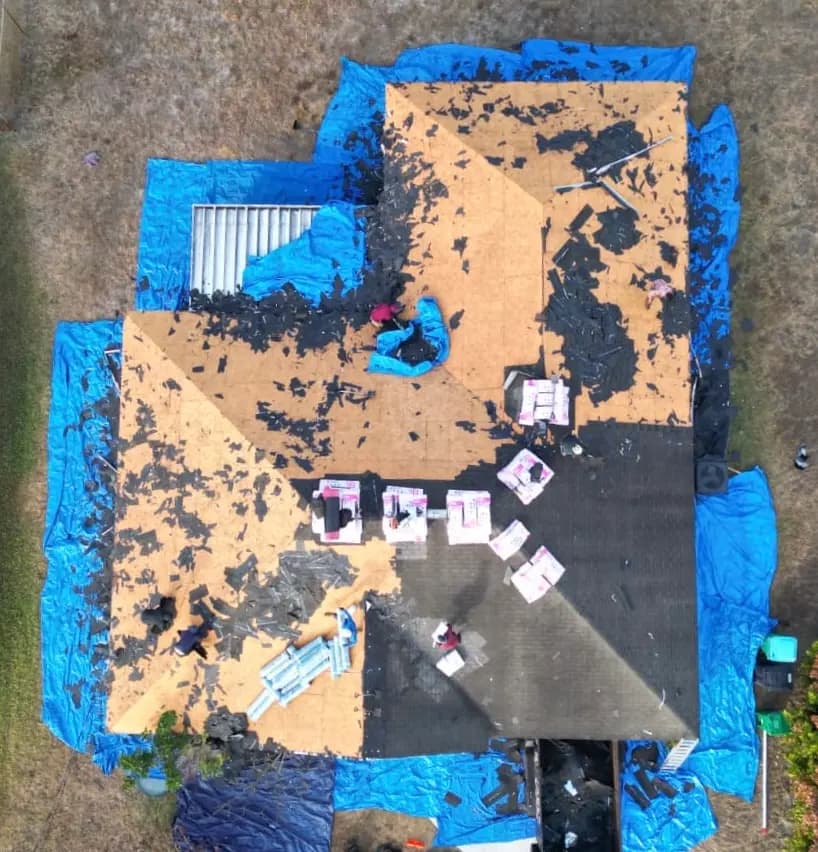
Clear loose debris. Cover any opening larger than a hand with half-inch plywood first. Run a heavy-duty tarp at least three feet past the damage in every direction.
Fold the leading edge under a 2x4 batten and fasten the batten through the tarp into solid roof deck with ring-shank nails or screws roughly every 12 inches, repeating on all four sides. Sandbag the corners and trim loose flaps so wind cannot catch them.
If the deck feels soft, or you cannot reach the damage without climbing a wet slope, stop and call a crew. A bad tarp install is how people get hurt and how the next gust makes the opening larger.
How long do I have to file a storm claim in Florida?
Florida Statute 627.70132 gives you one year from the date of loss for a new or reopened claim and 18 months for a supplemental claim. Report early anyway — carriers generally must acknowledge a claim within 14 days and issue a coverage decision within 90 days, and the sooner the file opens, the sooner the adjuster comes out.
Use the hurricane's landfall date as the date of loss when the damage came from that storm. Write down the claim number, the date and time you reported it, and the name of the person you spoke with. A supplemental claim is not the same filing as the original — Florida Statute 627.70132 gives that supplemental notice 18 months.
What damage should I look for after a Treasure Coast storm?
From the ground, look for missing or lifted shingles, cracked or slipped tile, and exposed or torn underlayment. Then check the metal at the edges, the ridge, and every place a pipe or wall meets the roof.
- Missing or lifted shingles
- Cracked or slipped tile
- Exposed or torn underlayment
- Bent or missing drip edge and perimeter metal
- Displaced ridge caps
- Damaged flashing at chimneys and vents
- Granules in the gutters
- Soffit and fascia damage
- Interior ceiling stains or attic daylight
What does emergency response look like in Port St. Lucie, Fort Pierce, and Stuart?
Reliable Roofer, Inc. answers 7:00 AM–7:00 PM daily at (772) 867-0000. The shop is in Port St. Lucie, and the same crew covers Port St. Lucie, Fort Pierce, and Stuart. Calls answered 7:00 AM–7:00 PM daily. Call the shop or send the address for a written estimate.
Active interior leaks are the priority. Temporary dry-in is used when it is safe and useful, then the permanent repair is scheduled from the photos. There is no same-hour arrival promise and no 24/7 claim on this site.
Port St. Lucie, Fort Pierce, and Stuart are the same license and the same written-scope rule. None of those city pages is a second office.
Do I need a permit for storm repairs in St. Lucie County?
Yes, for roof work of any size. St. Lucie County requires a permit for reroof work, and a final inspection is required on all roof and reroof permits. Work exceeding 25% of the existing roof area within a 12-month period must comply with Section 706.7 of the Florida Existing Building Code.
Temporary tarping to stop water is mitigation. The lasting repair still goes through the permit for the address. Your licensed contractor pulls that permit. The replacement guide explains the 25% rule, the inspection sequence, and when a partial repair turns into a full section.
Can I climb on my roof after a storm?
Stay off the roof. Wet decking and hidden structural damage are how people get hurt. Assess from the ground or from a window.
A wet, storm-loaded roof hides soft decking and open holes. Photos from the yard, a window, and the attic — if the attic is safe to enter — are enough to open the file. The roof walk belongs to a licensed crew.
Questions from this guide
No. Florida policies require you to take reasonable steps to prevent further damage, so emergency tarping is expected. Photograph the damage before the tarp, photograph the tarp going on, and keep the receipts.
Florida Statute 627.70132 gives you one year from the date of loss for a new or reopened claim and 18 months for a supplemental claim. Report early anyway — carriers generally must acknowledge a claim within 14 days and issue a coverage decision within 90 days, and the sooner the file opens, the sooner the adjuster comes out.
Stay off the roof. Wet decking and hidden structural damage are how people get hurt. Assess from the ground or from a window.
Next step
What should I do if water is in the house?
Call (772) 867-0000. Calls answered 7:00 AM–7:00 PM daily. Call the shop or send the address for a written estimate.
Call (772) 867-0000Reliable Roofer · 5.0★ · 60 Reviews · BBB A+